This article contains affiliate links to Nihoner. If you sign up through them, we may earn a commission at no extra cost to you. It does not affect which options we recommend.
What Nihoner actually is
Nihoner is a browser-based platform built specifically around learning Japanese, covering all four core skills — reading, writing, listening, and speaking — rather than just vocabulary or grammar in isolation. It bundles a large searchable dictionary, more than 120 structured courses spanning JLPT N5 through N1 (as of October 2026), and a set of vocabulary games into one account. You can sign up for free, with no card required, and all 16 games are free to play. The courses are the exception: as of October 2026, the free plan includes 18 starter lessons, while the full lessons across all of its more than 120 courses need Premium or Elite. The paid tiers also add extras like more daily reading passages.
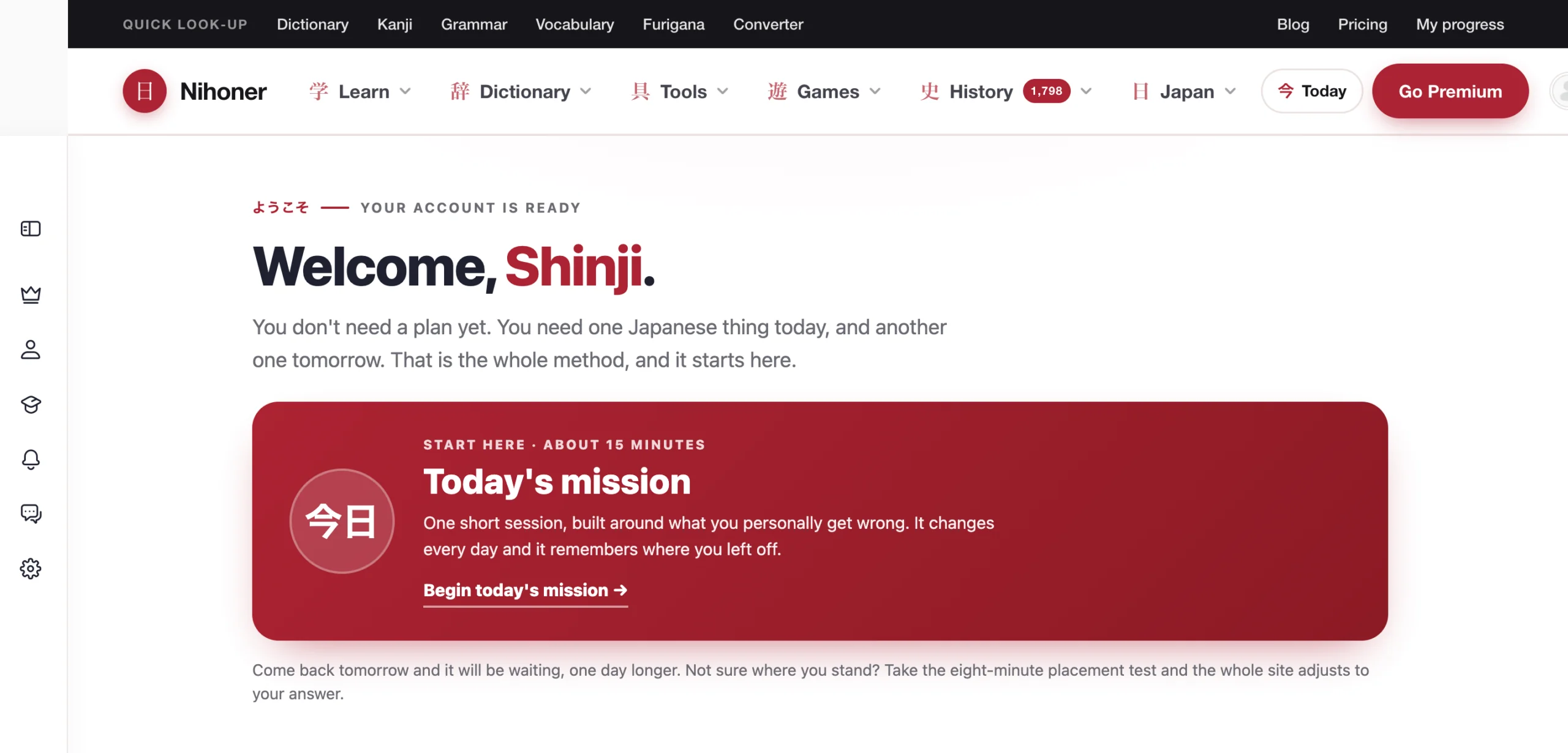
I already covered Nihoner briefly in my apps comparison roundup, but it deserves its own closer look, because “dictionary + courses + games in one place” undersells what it’s actually like to use day to day.
The dictionary
This is, in my opinion, Nihoner’s strongest feature. It’s built on a large database (Nihoner lists over 600,000 dictionary entries), and you can search by kanji, kana, reading, or lemma (the dictionary form of a word). You can also filter results by part of speech — nouns, verbs, adjectives, particles, and so on — which is genuinely useful once you’re past the absolute beginner stage and need to look up how a specific grammatical form behaves.
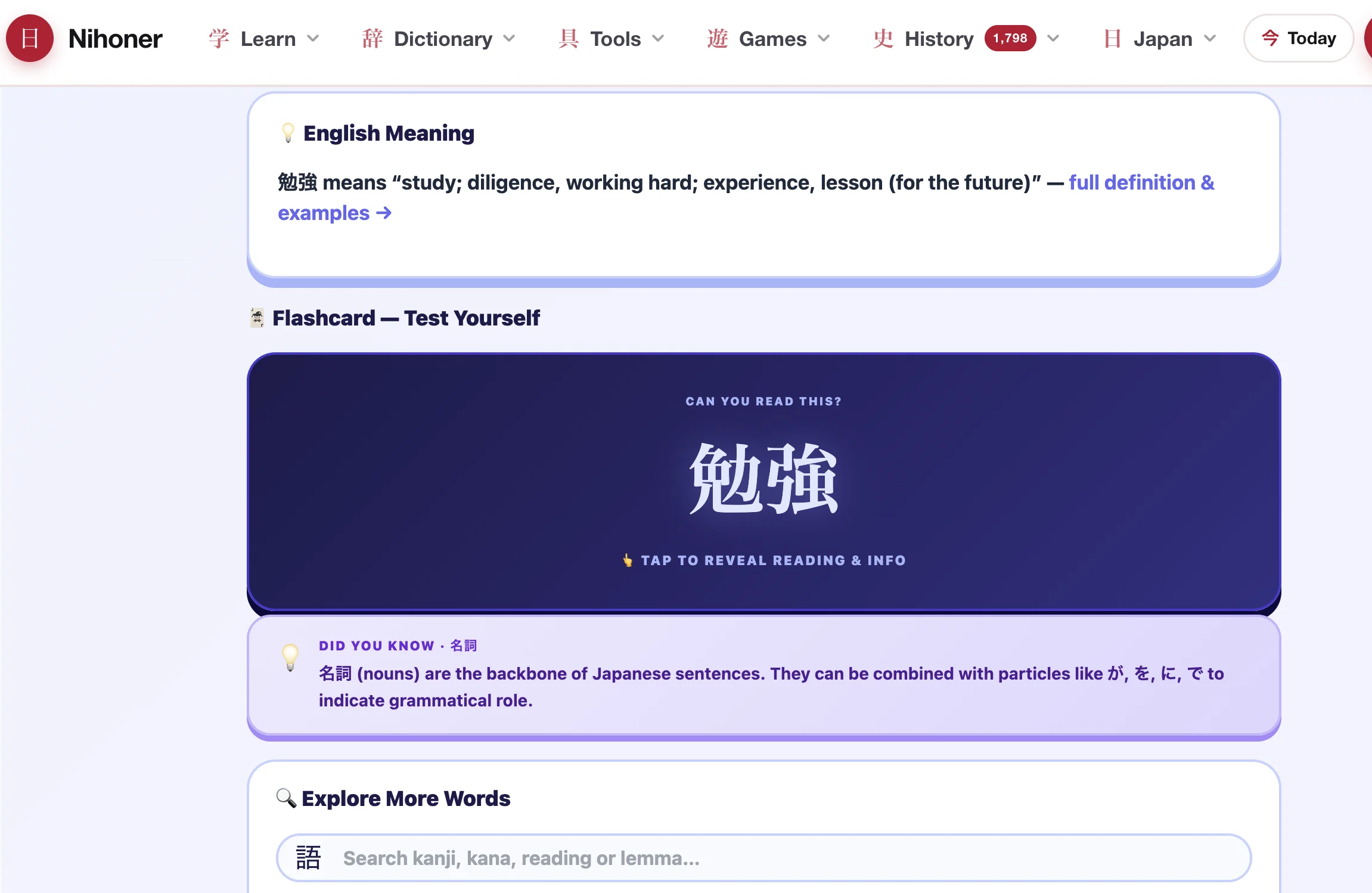
Each entry comes with an English meaning, a flashcard-style “test yourself” prompt, and a short “Did you know” note about the grammar category the word belongs to. It’s a small touch, but it means you’re not just memorizing a word in isolation — you’re picking up a bit of grammar context every time you look something up.
The courses
Nihoner’s courses are structured around grammar and kanji, organized in a way that’s meant to be worked through progressively rather than browsed randomly — more than 120 courses in total, spanning JLPT N5 through N1, with a JLPT-specific path that tracks exactly which kanji, vocabulary, and grammar points you’re still missing at each level. If you’ve used a textbook-style app before, the format will feel familiar: short lessons, comprehension checks, and a sense of “today’s step” rather than an open-ended library.
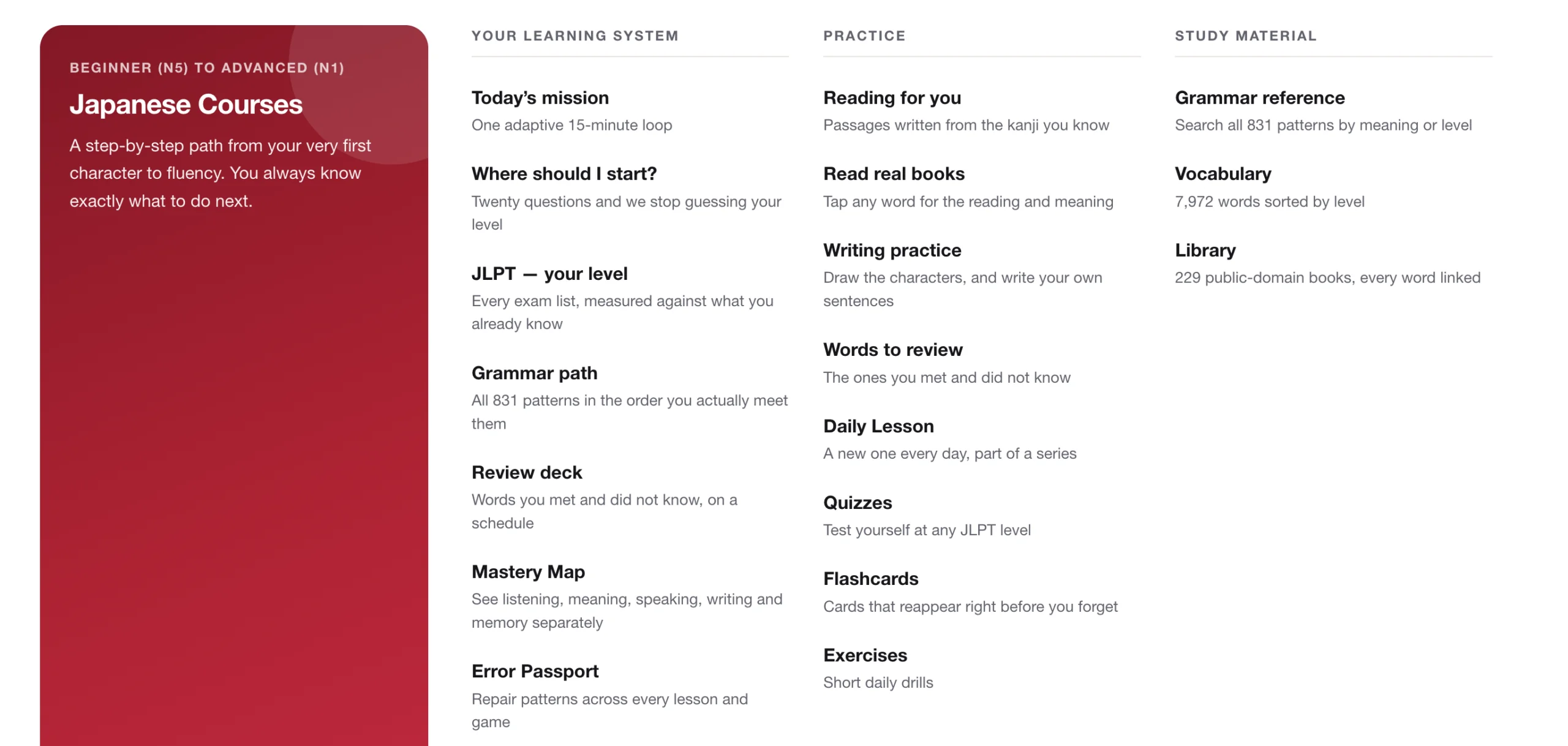
Good for: learners who want one place to go for “what should I study today” without having to build their own curriculum from scattered resources.
Worth knowing: the courses themselves aren’t conversation practice — that’s true even though Nihoner’s listening and keigo drills (Audio Samurai, Keigo Clash) can sharpen your ear, and Premium adds an AI pronunciation trainer. Courses are strong for building recognition and grammar understanding, but for an actual back-and-forth conversation with another person, you’ll still want to pair this with a tutor platform like italki or Preply.
The games
The vocabulary games cover the basics you’d expect — hiragana and katakana recognition, kanji drills, and vocabulary matching — but framed as short, low-pressure sessions rather than a full gamified progression system like Duolingo’s.
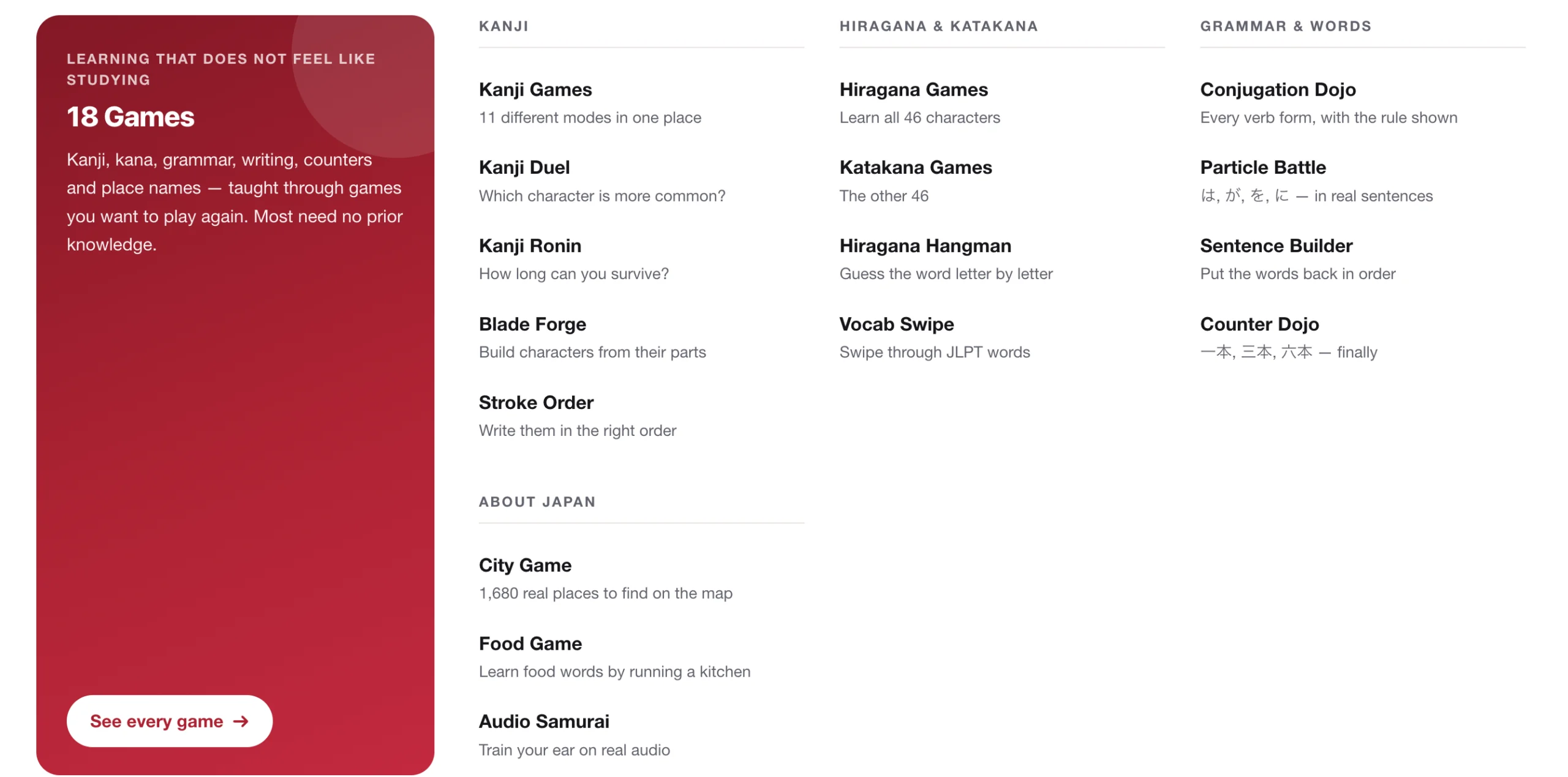
Good for: quick daily reinforcement, especially for kana recognition if you’re still in the early stages.
Worth knowing: all 16 games are free to play, including the full kanji, kana, and vocabulary game libraries. Only some of them ask you to create a free account just so your score and XP are saved — nothing paid required.
Free vs. paid
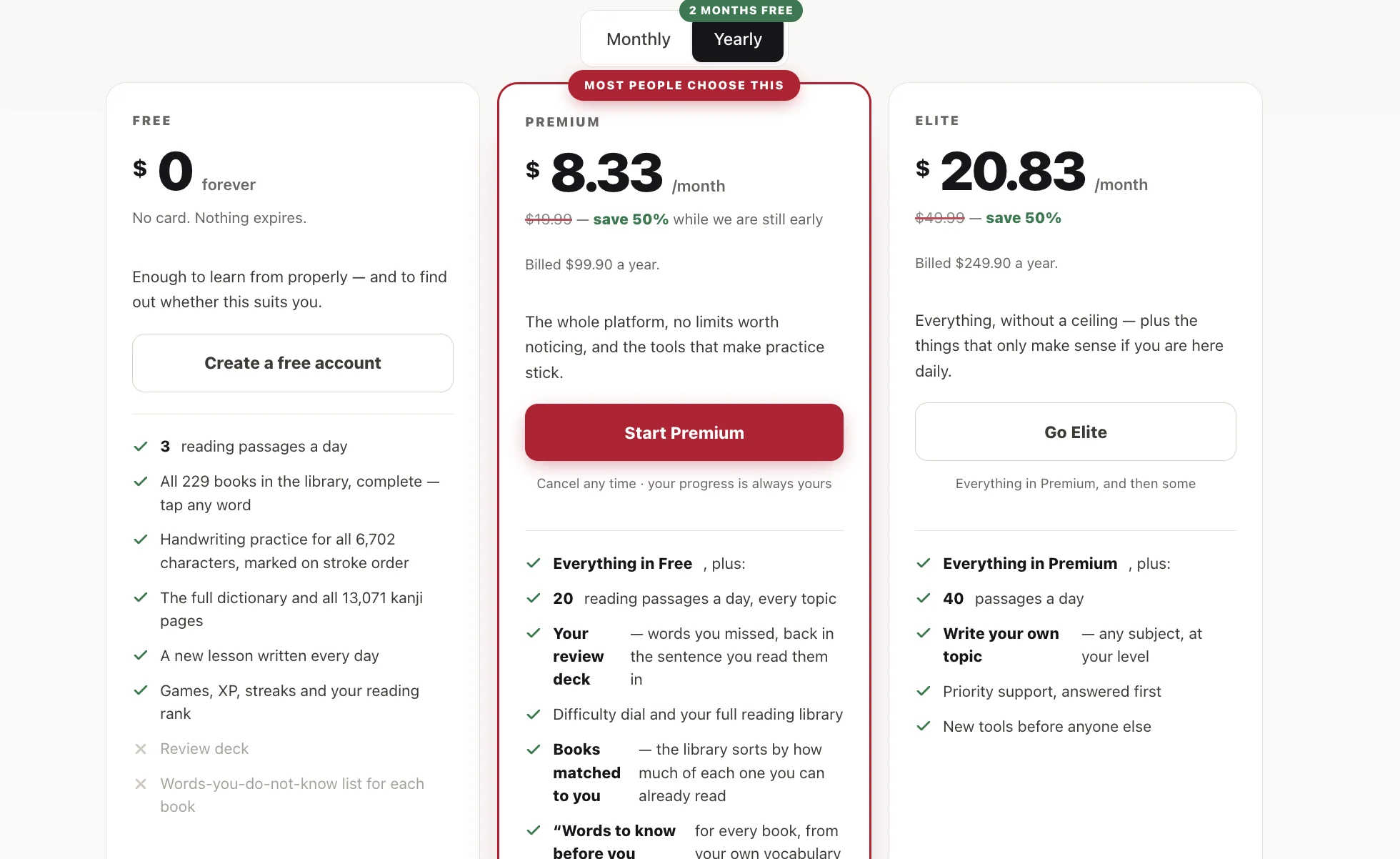
Nihoner offers three tiers: a free plan with no card required (18 starter lessons from the courses, all 16 games, the full dictionary, handwriting practice for all kanji, and 3 reading passages a day), a Premium plan at $9.99/month — an early-pricing discount off the regular $19.98, locked in for as long as you stay subscribed (every lesson in all of its more than 120 courses, 20 reading passages a day, an uncapped review deck, and a difficulty dial for your reading passages), and an Elite plan at $99.99/month, similarly discounted from $199.98 (40 passages a day, your own reading topics, and priority support). The library of public-domain books, including the sorting that ranks each book by how much of it you can already read, is free on every plan. Since this is early/introductory pricing, it’s worth double-checking the current numbers on Nihoner’s pricing page before signing up, as they may rise over time. The Premium tier is clearly the one aimed at most learners — Nihoner‘s own pricing page even flags it as the plan most people choose.
Who Nihoner is actually good for
- Good fit: learners who want a single Japanese-focused home base instead of juggling a separate dictionary app, grammar app, and flashcard app.
- Not the best fit alone: learners whose main bottleneck is holding an actual conversation with another person — Nihoner’s listening drills and, on Premium, its AI pronunciation trainer help with your ear and accent, but pair it with italki or Preply for real back-and-forth practice.


コメント