This article contains affiliate links to Nihoner. If you sign up through them, we may earn a commission at no extra cost to you. It does not affect which options we recommend.
What each one actually does
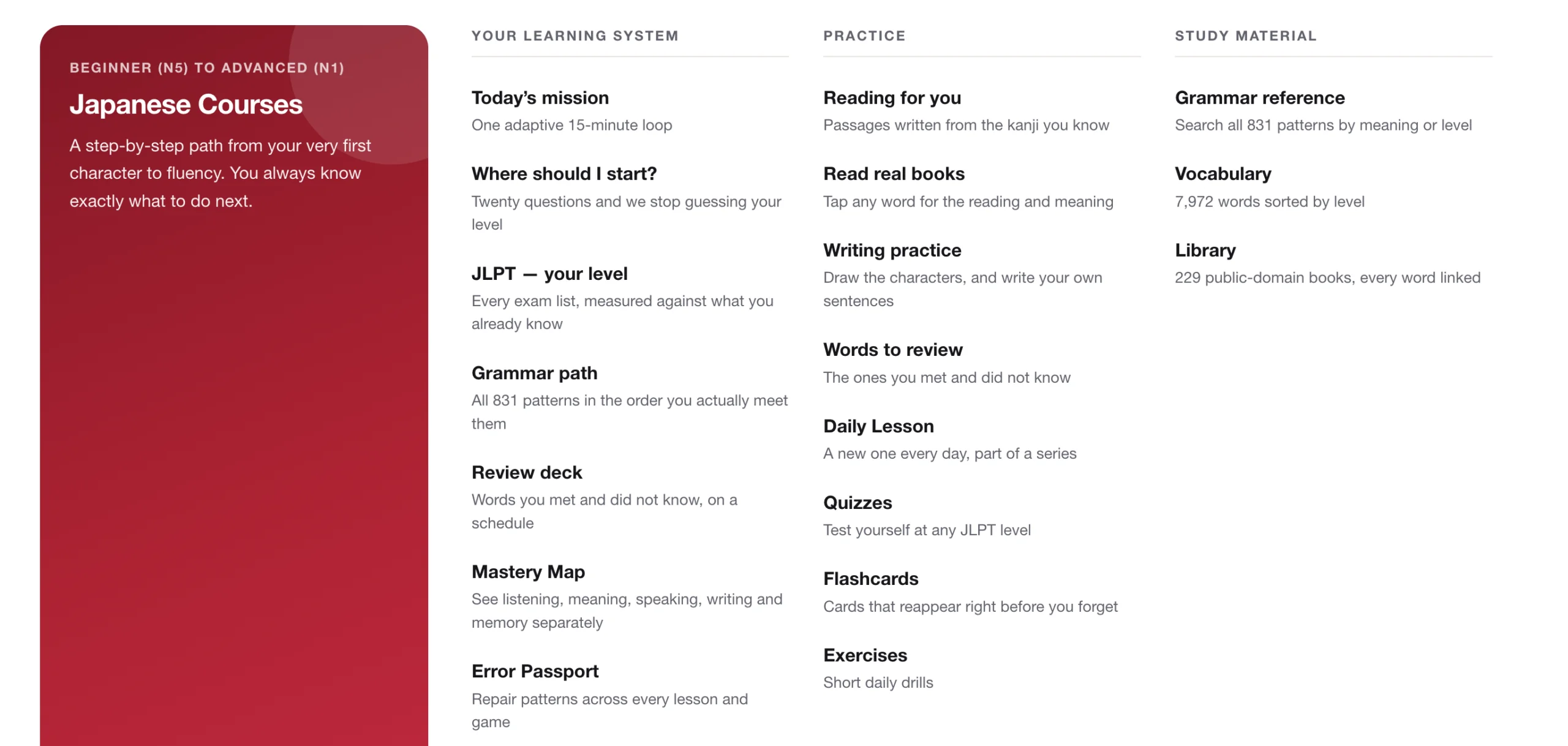
These two get compared a lot, but they’re not really solving the same problem. Duolingo is a gamified app built around short, repetitive lessons — streaks, XP, and pattern recognition are doing most of the teaching. Nihoner is closer to a study toolkit built around all four skills — reading, writing, listening, and speaking: a large searchable dictionary, more than 120 structured courses spanning JLPT N5 through N1 (as of October 2026), and a set of vocabulary games bundled into one browser-based account.
I covered both individually in my Nihoner review and my Duolingo review. This is the direct, side-by-side version for anyone trying to pick a starting point.
The short version: Duolingo teaches through repetition and exposure, with light explicit explanation. Nihoner leans more structured — a dictionary you can actually dig into, plus courses that resemble a textbook’s table of contents more than a game’s level map.
Content and structure compared
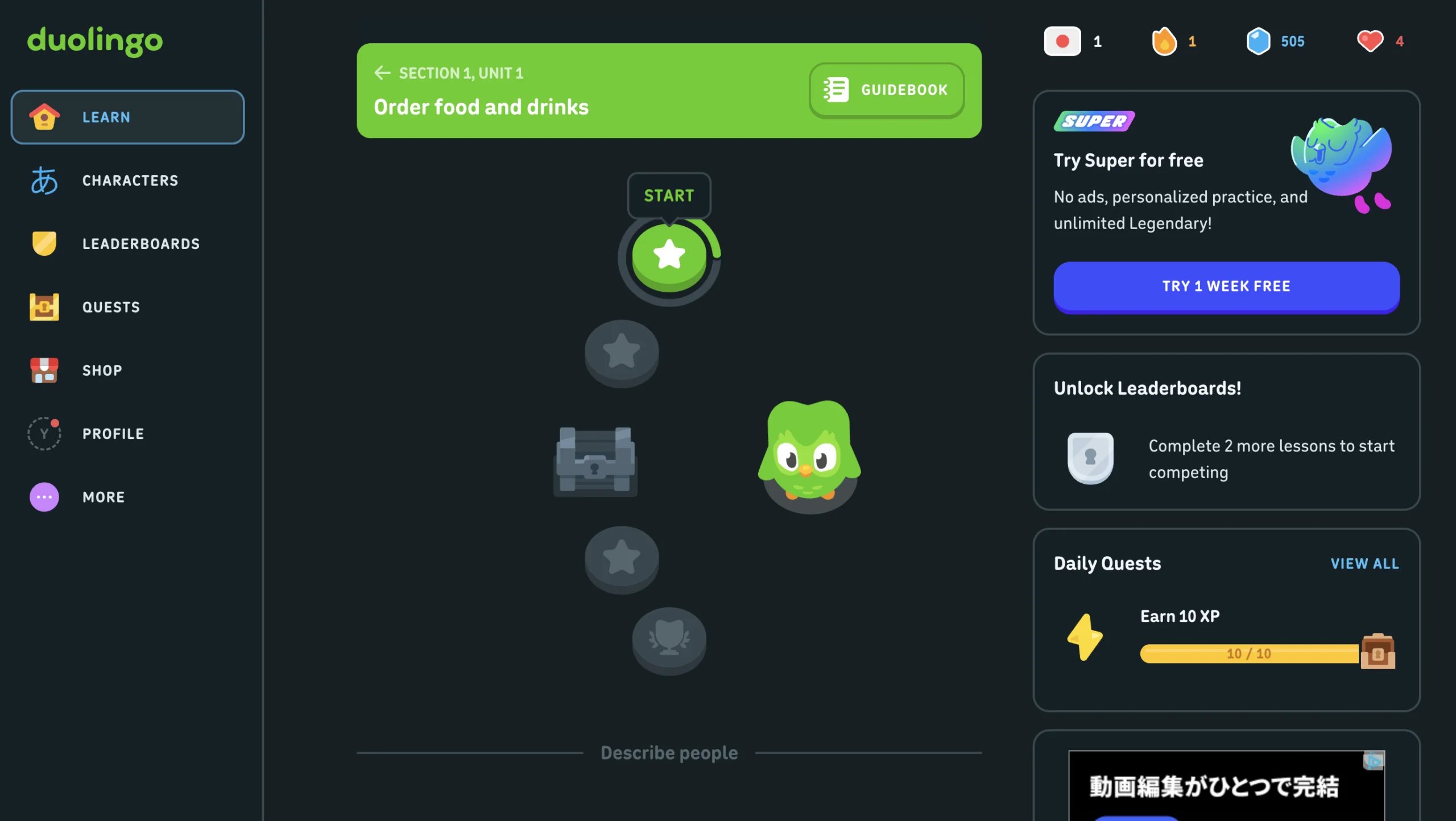
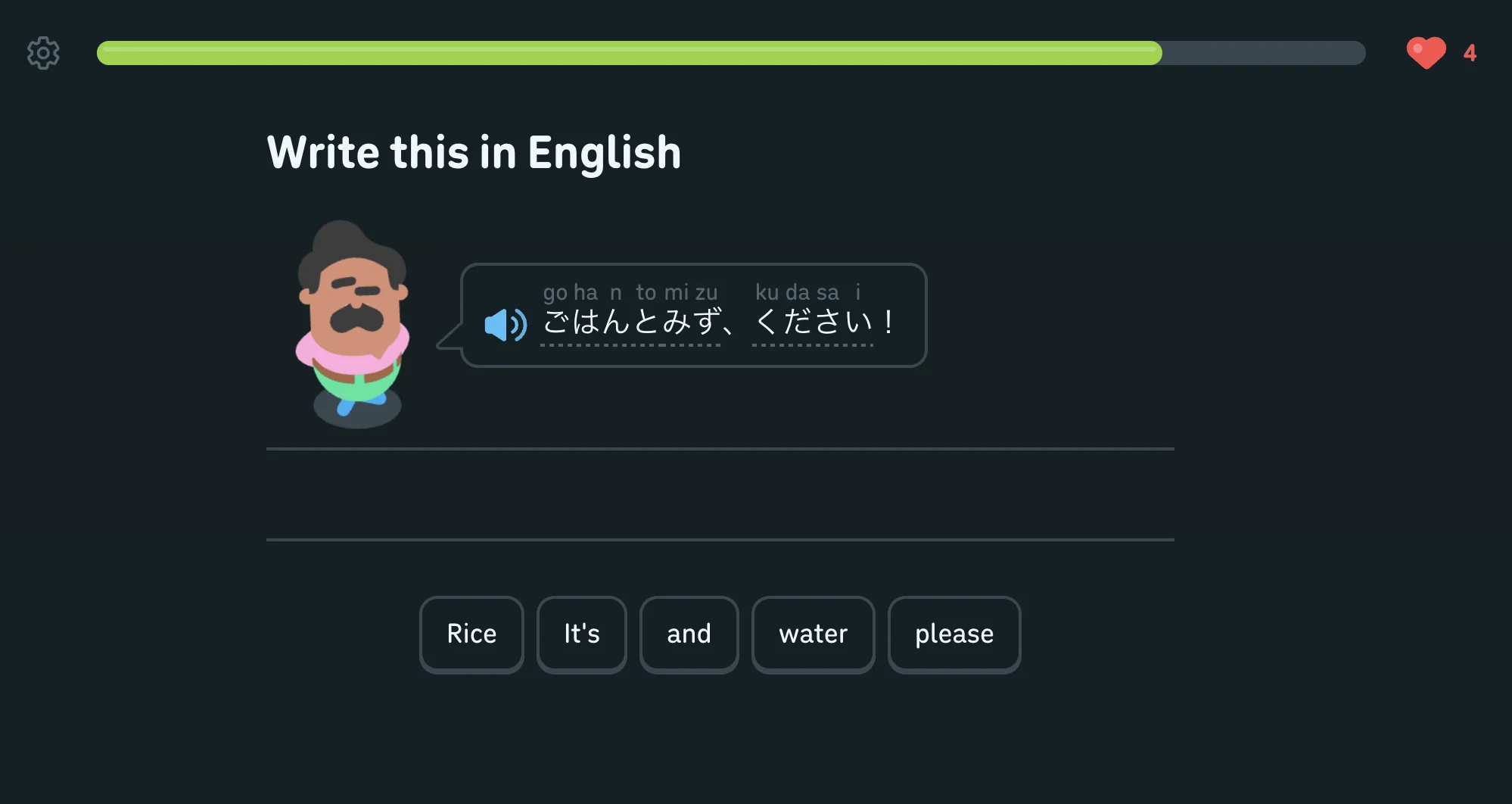
Duolingo is organized into units, each with a short Guidebook screen (key phrases and vocabulary) before you start its lessons. You move through units in a fixed path, and the format stays consistent the whole way: translate, match, listen and type.
Nihoner’s courses are organized more like a curriculum — more than 120 courses spanning JLPT N5 through N1, grammar and kanji ordered progressively, with a clearer sense of “this is today’s lesson” rather than a game board. It also has something Duolingo doesn’t: a real dictionary you can search by kanji, kana, reading, or lemma, with part-of-speech filters. That’s less useful in your first week, but it becomes genuinely valuable the moment you start reading real sentences and need to look something up properly instead of guessing from context.
Kana and kanji, specifically: both introduce kana early and both pair kanji with reading aids at first (Duolingo uses furigana; Nihoner’s dictionary and courses lean on stroke-order games and structured drills). Neither gets you to serious kanji volume — that’s a job for something dedicated like WaniKani once you’re past the basics.
What daily use feels like
This is where the two diverge the most. Duolingo’s sessions are built to be short and low-friction — a few minutes, gamified enough that the streak counter genuinely keeps you coming back on days you don’t feel like studying. It’s arguably the easier habit to stick with in month one.
Nihoner’s games are similarly short, but the overall experience feels less like “one continuous game” and more like moving between separate tools — dictionary lookup here, a course lesson there, a quick vocabulary game to reinforce it. That’s not a criticism exactly; it just means Nihoner rewards a bit more self-direction, while Duolingo is built to need less of it.
Honest take: if you’re the kind of learner who needs the app to create the motivation for you, Duolingo’s gamification does that job better. If you already have some self-discipline and want a tool that gets out of your way once you know what you’re looking for, Nihoner’s dictionary-first design fits better.
Free vs paid
Both have a free tier worth using, which is part of why they get compared so often, but they’re free in different ways.
| Nihoner | Duolingo | |
|---|---|---|
| Free tier | Dictionary, all 16 games, the reading library, JLPT and grammar paths, and 18 starter lessons from the courses | Full lesson content, with ads and limited mistakes (“hearts”) |
| Paid tier | Every lesson in all of its more than 120 courses, more daily reading passages, an uncapped review deck, the AI pronunciation trainer and other extra tools | Removes ads/hearts, adds extra practice modes |
| What you lose without paying | Most course lessons (only the starter lessons are free), plus a cap on daily reading passages and a few review, writing and pronunciation extras | Not much — free tier covers real content |
Duolingo’s free tier is closer to “the full product with friction.” Nihoner’s free tier has a different shape: the dictionary, all 16 games, the reading library and the JLPT and grammar paths are free, but the structured courses at its center are mostly behind Premium, currently $9.99 a month at its early-pricing discount (check its pricing page for current numbers). If you’re drawn to Nihoner mainly for the games, the dictionary or the reading library, the free tier genuinely covers that; if you’re drawn to the courses, plan on paying for Premium. If you’re using Duolingo, the free version alone is enough to build a real foundation.
Which one should you start with
If you’re an absolute beginner who hasn’t studied any Japanese yet, start with Duolingo. The gamification does real work in the first few weeks — it’s the easier habit to build, and it gets you through kana and a first layer of vocabulary without much friction. I go through that groundwork in more detail in my hiragana and katakana guide.
Once kana feels solid and you’re a few weeks in, add Nihoner rather than switching to it. Use it for the dictionary the moment you start needing to look things up properly, lean on its courses once you want something more structured than Duolingo’s unit path (past the free starter lessons, that’s where Premium comes in), and its listening games and Premium AI pronunciation trainer once you’re ready to work on your ear and accent — especially if you’re working toward a specific target like JLPT N5. Because the courses need Premium, starting free with Duolingo also lets you build the habit first and decide on the subscription later.
Neither one replaces a live conversation partner. Nihoner’s listening games, its Premium AI pronunciation trainer and Duolingo’s audio exercises can sharpen your ear and your accent, but neither puts you in an actual back-and-forth exchange with another person. Once you’re past the very beginning, pair whichever combination you land on with real conversation practice through italki or Preply for that missing piece — that’s true regardless of which of these two you start with.


コメント