
What Duolingo’s Japanese course actually covers
Duolingo is the most widely used language-learning app in general, and its Japanese course wraps vocabulary, basic grammar, and some kanji into short, gamified lessons — a few minutes each, built around streaks, XP, and a friendly-but-relentless mascot reminding you to keep going.
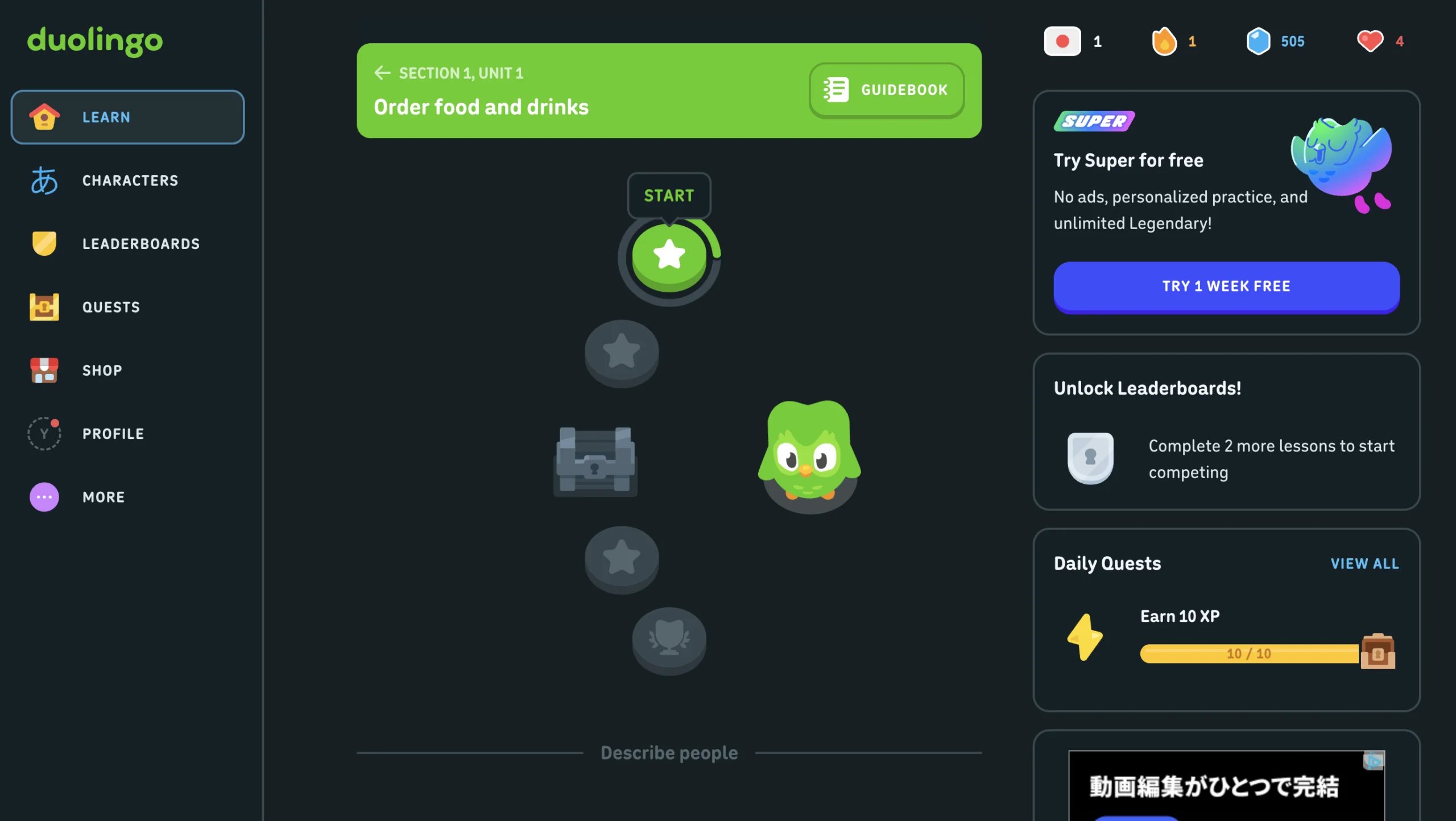
I covered Duolingo briefly in my apps comparison roundup. This review goes deeper into what the course actually teaches and, more importantly, what it doesn’t.
What a typical lesson is like
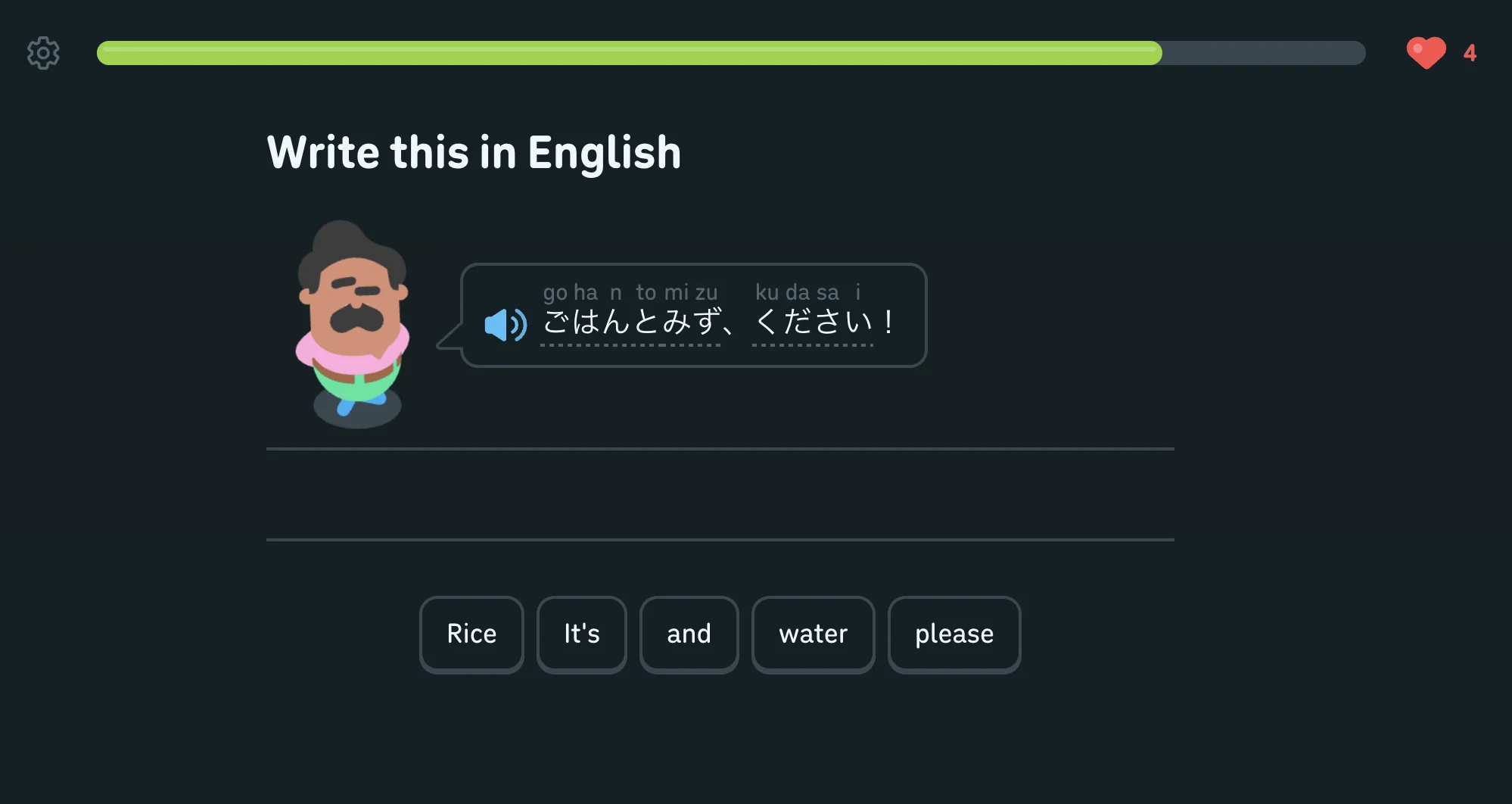
Lessons rotate through exercise types: translate a sentence, match word pairs, pick the correct character, listen and type what you hear. The format is genuinely well-designed for showing up daily — short enough that skipping feels like a real choice rather than an unavoidable time crunch.
Honest take: the gamification works. I found myself opening the app on days I genuinely didn’t feel like studying, purely because the streak counter is annoyingly effective. That’s a real strength, not a gimmick — consistency beats intensity for language learning, and Duolingo is unusually good at generating consistency.
Where it falls short
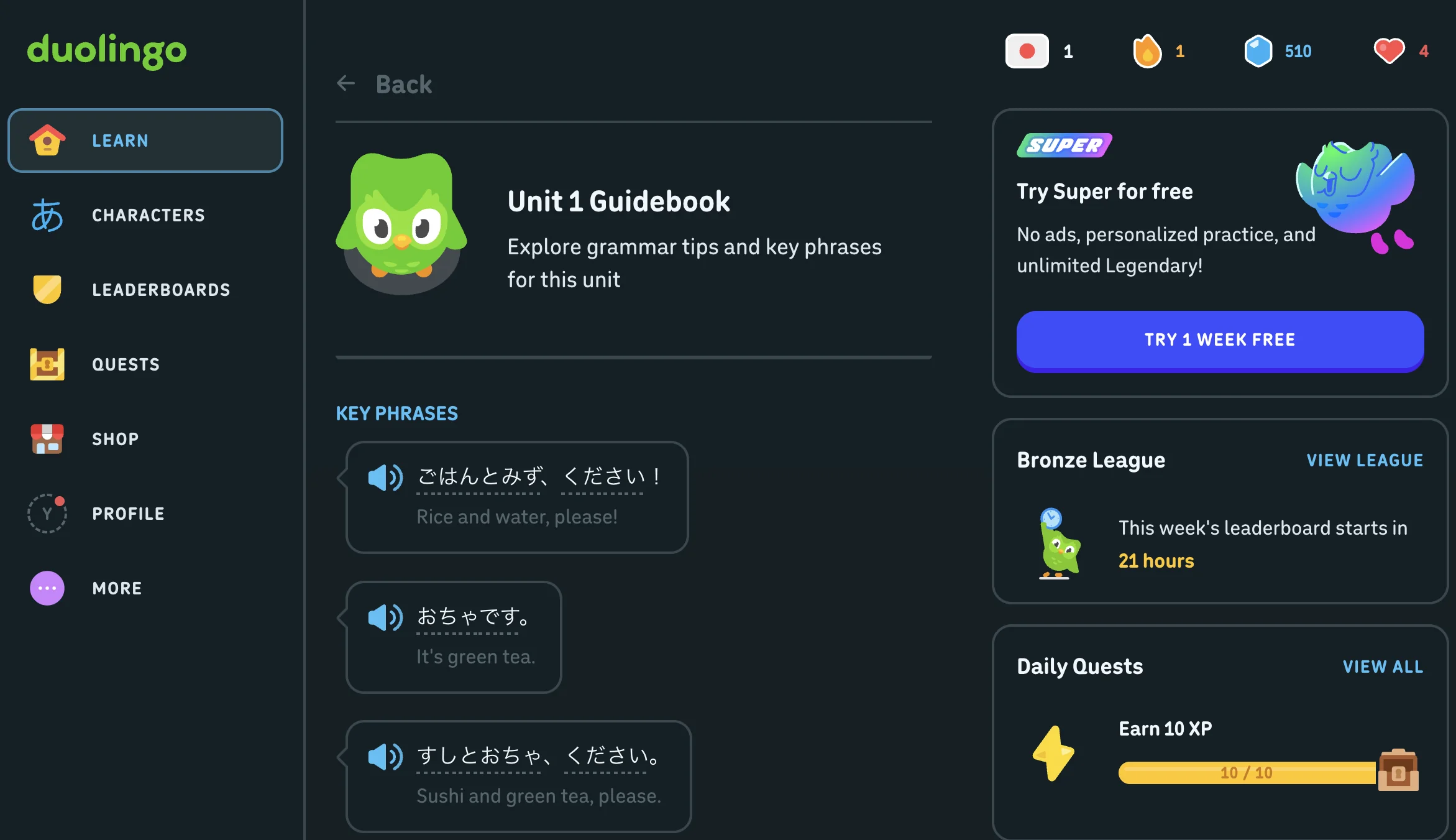
This is the part most reviews undersell. Duolingo teaches vocabulary and grammar patterns largely through pattern recognition and repetition, without much explicit grammar explanation. Each unit does have a Guidebook screen — accessible before you start that unit’s lessons — showing the key phrases and vocabulary you’re about to cover, but you’ll still learn to produce correct sentences before you necessarily understand why they’re structured that way. That’s fine for some learners, frustrating for others who want the underlying rule spelled out.
Kanji coverage is also thinner than a Japanese-specific tool. Duolingo introduces kanji gradually alongside furigana (reading aids), which is a reasonable approach for absolute beginners, but it won’t get you to serious kanji literacy on its own — pairing it with something like WaniKani once you’re past the basics fills that gap.
And there’s no real speaking practice. Duolingo has some listening and pronunciation-adjacent exercises, but nothing close to an actual conversation. If your goal is talking to people, not just reading and recognizing, you’ll need to pair this with italki or Preply eventually.
Free vs. Super
The free version is genuinely usable — full lesson content, just with ads and a limited number of mistakes allowed per session (“hearts”). Duolingo Super removes both and adds some extra practice modes. For Japanese specifically, the free tier is enough to build a real foundation; Super is more about removing friction than unlocking essential content.

How far can free actually take you?
Realistically: solid hiragana and katakana recognition, a genuinely useful base of common vocabulary, and enough grammar pattern-recognition to understand simple sentences — roughly comparable to an early-intermediate starting point, not fluency. It’s an excellent on-ramp and a weak finish line. Nobody reaches conversational Japanese from Duolingo alone, and the app doesn’t really claim otherwise once you’ve used it for a while.
Who Duolingo is actually good for
- Good fit: absolute beginners who want a low-pressure, genuinely free way to build the habit of daily study and a first layer of vocabulary and kana — exactly the use case I recommended in my hiragana and katakana guide.
- Not the best fit alone: anyone past the beginner stage who needs real grammar explanation, serious kanji volume, or actual speaking practice — Duolingo works best as a starting point you graduate from, not a complete solution.


コメント