This article contains affiliate links. If you sign up through them, we may earn a commission at no extra cost to you. It does not affect which options we recommend.
- The short answer
- Tuition: what schools actually charge
- Housing: dorms vs apartments vs homestay
- Daily living costs
- One-time costs people forget
- Online tutoring: the low-cost comparison
- How to budget realistically
- FAQ
- Is studying Japanese in Japan actually more expensive than studying at home?
- Can I reduce costs by choosing a cheaper city instead of Tokyo?
- Do scholarships or discounts meaningfully offset these costs?
- Does the JLPT level I’m studying toward affect my costs at all?
- Is it worth paying more for a highly-rated school over a cheaper one?
- Related reading
The short answer
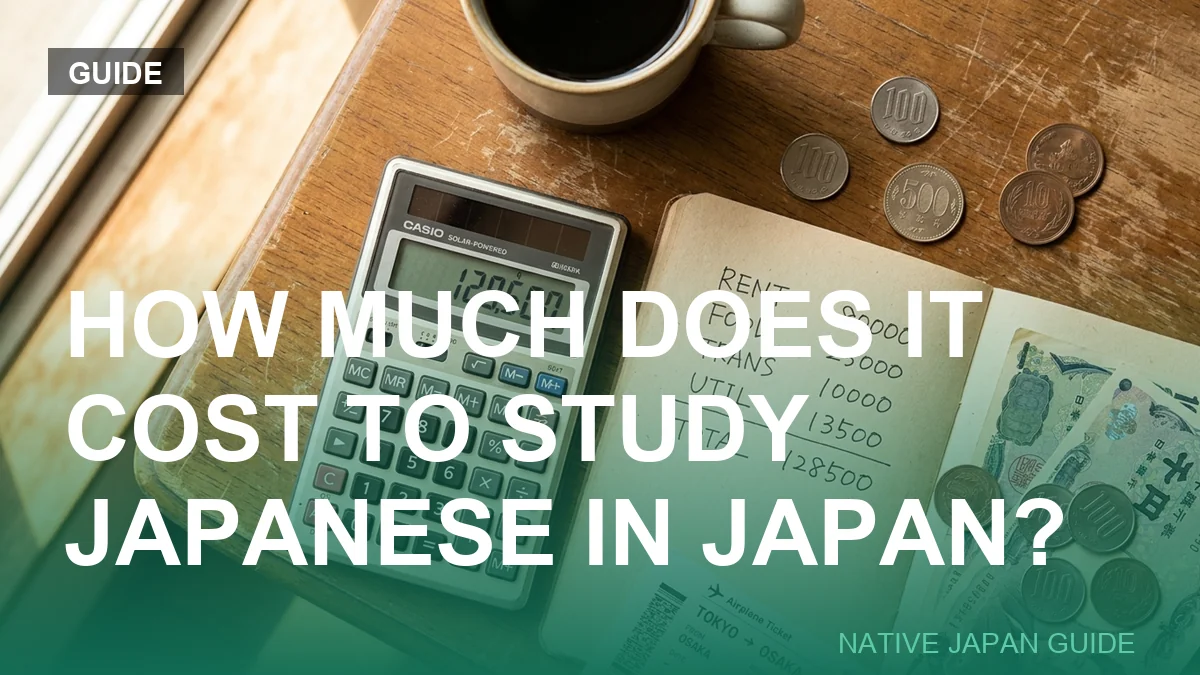
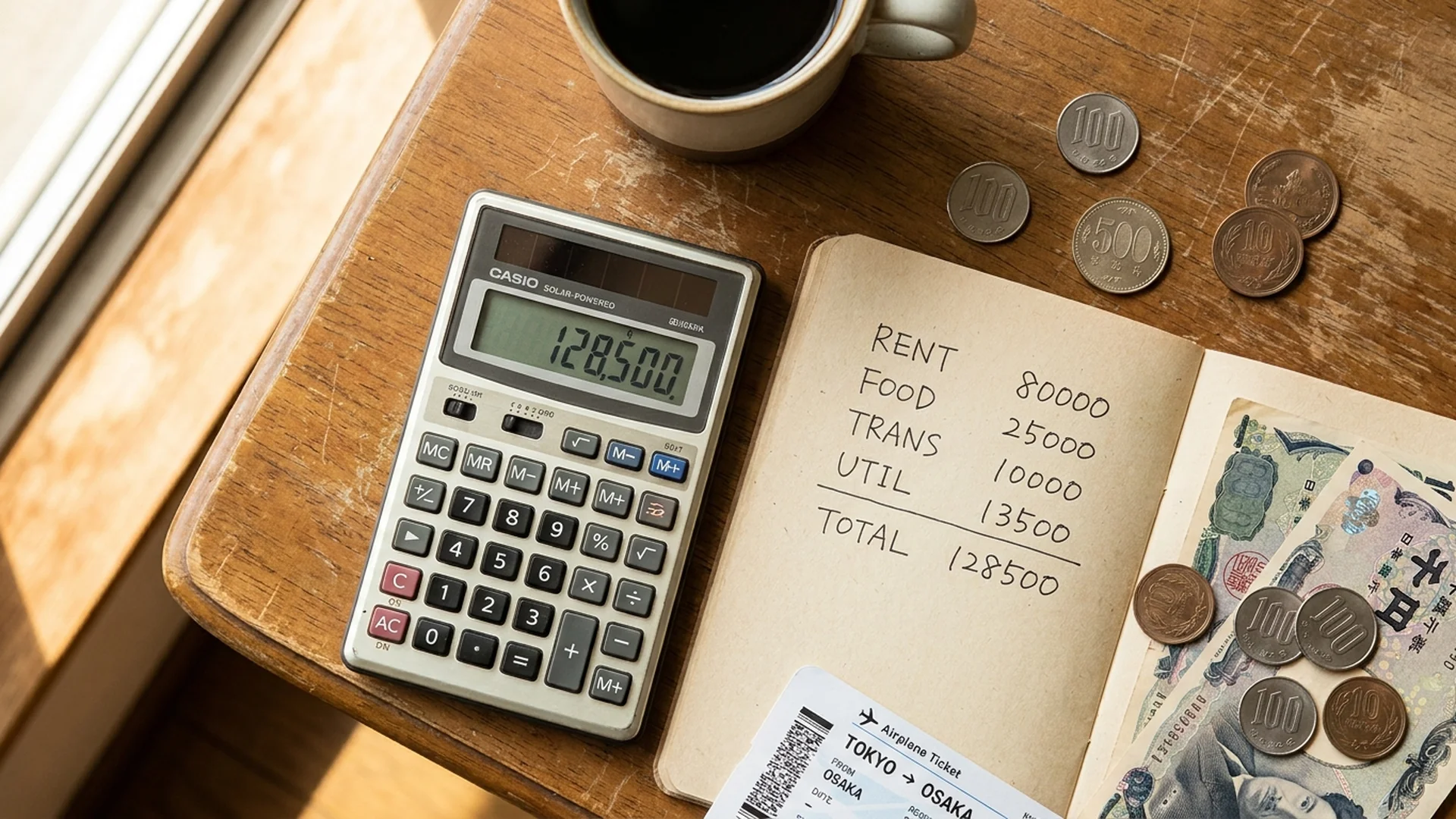
As a native Japanese speaker who fields cost questions constantly from people planning to study in Japan, here’s the blunt version: there’s no single honest number, because tuition, housing, and lifestyle choices swing the total by tens of thousands of dollars depending on program length, city, and how you choose to live. What you can actually budget for is a set of ranges — tuition per term, monthly housing and living costs, and a handful of one-time costs that catch people off guard — added up for your own specific situation, rather than a total someone else quotes you.
The rest of this breaks each piece down separately, adds a lower-cost comparison point in online tutoring, and ends with a practical way to build your own estimate instead of borrowing someone else’s.
Tuition: what schools actually charge
As covered in Japanese Language School vs Online Tutoring, intensive language school tuition alone — before housing or living costs — commonly runs from the mid-thousands to over ten thousand dollars USD for a multi-month term at schools in Japan, with the exact figure depending heavily on term length, school reputation, and location. A short three-month term at a mid-range school tends to sit toward the lower end of that range; a longer six-to-twelve-month enrollment, or a well-known school in a major city, pushes toward the higher end.
Billing structures vary too, and this is where a lot of confusion creeps in. Some schools bill per term and expect payment upfront; others quote an annual figure and split it into installments. Some separate an admission fee from tuition itself and list it as a distinct line item; others fold it into one number. None of this is standardized across schools, which is exactly why quoting one specific figure here would be misleading rather than helpful.
Schools publish current fees on their own sites, and those figures change often enough — sometimes year to year — that checking directly against your actual target schools’ current published pricing is the only reliable way to budget, not a number from an article written at some point in the past.
Housing: dorms vs apartments vs homestay
Housing is where the total cost of studying in Japan often splits furthest from what people expect walking in, mostly because the three common options work on completely different cost structures, not just different price points.
School-operated dormitories are usually the cheapest and simplest option on paper — commonly somewhere in the ¥30,000 to ¥70,000-a-month range, sometimes with basic utilities bundled in. The tradeoff is limited availability (popular schools fill dorm spots fast), shared facilities, and less say over location or roommates. If a school offers a dorm and you’re budget-conscious, it’s usually worth applying for one early rather than assuming a spot will be there closer to your start date.
Private apartments — typically a small studio or 1K/1DK unit — give you the most control and the widest price range, roughly ¥60,000 to ¥120,000 a month depending heavily on the city and how central the location is. Tokyo and Osaka sit toward the higher end; smaller cities can undercut that range meaningfully. The catch isn’t the monthly rent itself so much as the upfront costs layered on top, which the next section covers separately because they’re easy to underestimate.
Homestays sit somewhere in between on a pure rent basis, often ¥50,000 to ¥80,000 a month, but the number is deceptive because it usually includes some or all meals, which shifts real money out of your daily food budget and into the homestay fee. A homestay with two meals a day included can end up cheaper overall than an apartment plus groceries, even though the sticker number looks similar or slightly higher.
These ranges aren’t pulled from a housing survey or official statistics — they’re a general market-sense estimate, and the real number for any specific room varies substantially by your own lifestyle, the season, and the city. Treat them as a starting point for comparison shopping, and check current listings on real estate sites or directly with a school’s housing office before locking anything into a spreadsheet.
Daily living costs
Once housing is settled, the recurring monthly costs that actually determine how comfortable — or tight — your budget feels come down to a fairly predictable handful of categories.
Food is the biggest of these and the most controllable. Cooking most meals yourself, shopping at a standard supermarket rather than convenience stores, commonly lands somewhere around ¥30,000 to ¥50,000 a month for one person. Eating out regularly, even at inexpensive places, pushes that toward ¥60,000 or higher without much effort. This is genuinely the line item most within your control, and it’s worth treating it that way rather than assuming a fixed number applies to you.
Local transportation — trains and buses for daily commuting to school — typically runs ¥5,000 to ¥10,000 a month if you’re using a student commuter pass on a reasonably short route, more if your housing ends up farther from campus than planned. It’s worth factoring commute distance into a housing decision rather than treating the two as unrelated line items.
Phone and internet together usually come to somewhere around ¥3,000 to ¥6,000 a month if you go with a budget SIM-only plan rather than a full carrier contract, which is the route most students end up on anyway given contract length requirements that don’t suit a limited-duration stay.
Stack food, transport, and phone/internet together and a single person living modestly is generally looking at roughly ¥40,000 to ¥65,000 a month on top of rent. Like the housing figures above, this isn’t drawn from a cost-of-living survey — it’s a general estimate, and how much you actually spend depends heavily on your own habits, the season, and the city, so check current local prices rather than treating this as a fixed number.
One-time costs people forget
This is the section that trips up more budgets than tuition or rent ever does, because these costs show up once, often right at the start, exactly when you’re already spending the most.
An admission fee (入学金, nyūgakukin) is common at Japanese language schools and is sometimes quoted separately from tuition rather than folded into it — commonly somewhere in the ¥20,000 to ¥30,000 range, though this varies by school and is exactly the kind of figure worth confirming directly rather than assuming.
Apartment-hunting in Japan carries its own set of one-time costs that catch people who haven’t rented here before completely off guard. A security deposit (敷金, shikikin) — typically one to two months’ rent, usually refundable minus cleaning costs — is standard. Key money (礼金, reikin), a non-refundable payment to the landlord historically common across much of the country, still shows up on plenty of listings, though it’s become less universal and more negotiable than it used to be, especially outside major cities. On top of that, landlords frequently require a Japanese guarantor for the lease; if you don’t have one, a guarantor company (保証会社) will typically cover that role for a fee, often equivalent to roughly half a month’s rent to a full month’s rent, paid once at signing.
Textbooks and course materials add up over a term — commonly ¥10,000 to ¥30,000 depending on the level and how many separate books the course requires, since some schools bundle a full set at enrollment while others have you buy per-term as you progress.
Visa and paperwork costs are smaller individually but easy to forget as a category. The Certificate of Eligibility application has no filing fee, but the visa itself does: the Ministry of Foreign Affairs lists roughly ¥15,000 for a single-entry visa for applications accepted from July 1, 2026, with the amount varying, or no fee at all, depending on purpose and nationality. Getting there also involves real costs: document preparation, notarization or apostille fees on certain paperwork, courier costs for sending documents to and from Japan, and sometimes translation fees if your documents aren’t already in Japanese or English. None of these individually breaks a budget, but as a group they’re worth setting aside a few hundred dollars for rather than assuming the visa itself is the only expense in this category — a distinction covered in more depth in Do You Need JLPT to Study in Japan?, which walks through the actual visa requirement itself, and in Student Visa for Japanese Language School, which walks through how the application process unfolds.
Online tutoring: the low-cost comparison
Every number above assumes relocating to Japan and enrolling in a physical school, which is only one path. Online tutoring is worth putting on the same page specifically because the cost gap between the two is large enough that it changes the decision for a lot of people, not just a minor difference in convenience.
Individual online lesson prices are set by each tutor, and commonly seen rates run from around $5 for a short trial lesson to $40 or more per hour depending on the tutor’s credentials and the platform, though these aren’t official rates. Providers also structure billing differently — some charge per lesson, others run tutor-specific subscriptions that renew on a fixed cycle (every 28 days on Preply) rather than pay-per-lesson, which changes the math over a billing period even at similar lesson prices. Someone doing two hour-long lessons a week for a few months is spending a small fraction of even the lower end of a school term’s tuition, before you even add in the housing and relocation costs a physical program requires and tutoring doesn’t.
If flexible, pay-as-you-go lessons fit your situation better, italki is the more open starting point — a full tutor directory with no recurring charge if you just want to sample a few teaching styles before committing. If you know that unstructured flexibility is exactly how you’d let lessons slide, Preply‘s tutor-specific subscription model builds in a small amount of commitment pressure that some learners genuinely need to actually show up consistently.
Self-study sits lower still on cost: a platform such as Nihoner has a free membership with starter lessons, games, a dictionary and a reading library, while its full courses need Premium, currently about $9.99 a month at the promotional price (check its pricing page for current plans). That keeps a self-study base inexpensive to combine with lessons.
This isn’t a claim that online tutoring replaces everything a physical school provides — immersion, daily structure, and being surrounded by the language aren’t things a weekly video call fully replicates. But on cost alone, it’s the clear low end of the range, and worth budgeting against directly if cost is a deciding factor rather than just a secondary concern.
How to budget realistically
Rather than hunting for someone else’s total and hoping it applies to your situation, building your own estimate from the pieces above takes maybe twenty minutes and produces a number you can actually trust.
Start with tuition for your actual target schools and term length, pulled from their current published pricing, not an average from an article. Add your chosen housing type’s monthly rate multiplied by however many months your program runs. Add daily living costs — food, transport, phone — at the same monthly rate, multiplied by the same number of months. Then add the one-time costs as a separate lump sum: admission fee, apartment move-in costs if applicable, materials, and visa-related paperwork costs, since these hit once rather than scaling with program length.
Once you have that number, build in a buffer — somewhere around ten to fifteen percent — for the reality that exchange rates move, prices creep up year over year, and unplanned costs (a broken phone, a longer stay than planned, a friend’s wedding back home) show up regardless of how carefully you planned. A budget with zero slack isn’t a realistic budget, it’s a best-case scenario wearing a realistic-looking spreadsheet. Don’t count on part-time income to close a gap, either: the Immigration Services Agency says tuition and living costs can’t be covered entirely by part-time work, and the rules for working on a student visa cap the hours.
Finally, revisit the number a few months before departure, not just once at the planning stage. Fees change, exchange rates shift, and your own plans sometimes do too — a budget built a year in advance and never touched again is exactly the kind of number that turns out to be wrong in ways that matter.
FAQ
Is studying Japanese in Japan actually more expensive than studying at home?
Usually, yes, once you account for relocation, housing, and daily living costs on top of tuition — online tutoring or self-study at home avoids most of that entirely. Whether the difference is worth it depends on how much you value immersion and daily structure, which is a personal call this article isn’t trying to make for you.
Can I reduce costs by choosing a cheaper city instead of Tokyo?
Generally yes, particularly on the housing and daily-living side — smaller cities tend to run noticeably cheaper on rent than Tokyo or Osaka. Tuition differences between cities tend to be smaller than the housing and living-cost differences, so city choice matters more for your monthly budget than for your tuition line.
Do scholarships or discounts meaningfully offset these costs?
Some do exist — need-based, merit-based, or tied to specific programs and partner schools — and they’re worth researching directly through target schools and Japanese government scholarship programs rather than assuming they don’t apply to your situation. They’re not universal or guaranteed, so budget as if you won’t get one and treat any scholarship you do land as a bonus rather than a plan.
Does the JLPT level I’m studying toward affect my costs at all?
Not directly — tuition is based on the program and term length you enroll in, not your current JLPT level. Where it matters is placement: a stronger starting level, built up through something like the JLPT N5 Roadmap before you go, can place you into a higher class outright, which sometimes shortens the total time — and total cost — needed to reach your actual goal.
Is it worth paying more for a highly-rated school over a cheaper one?
That depends on what you’re optimizing for rather than being a universal yes or no. A pricier, well-known school isn’t automatically a better fit for your specific level and goals than a cheaper one with a program structure that suits you better — this article deliberately avoids recommending specific schools for exactly that reason, since the right fit is genuinely individual.


コメント