
This article contains affiliate links to Nihoner. If you sign up through them, we may earn a commission at no extra cost to you. It does not affect which options we recommend.
Why kanji feels impossible at first (and why it isn’t)
Kanji breaks people in a specific, predictable way, and it’s worth naming the pattern before fixing it. Most learners start by staring at the total — over 2,000 characters in general use — and treat that number as the actual task, which is a bit like deciding you can’t start running because a marathon is 26 miles. The total is real, but it’s not what you’re doing on any given day, and treating it as the daily unit of work is the first thing that burns people out.
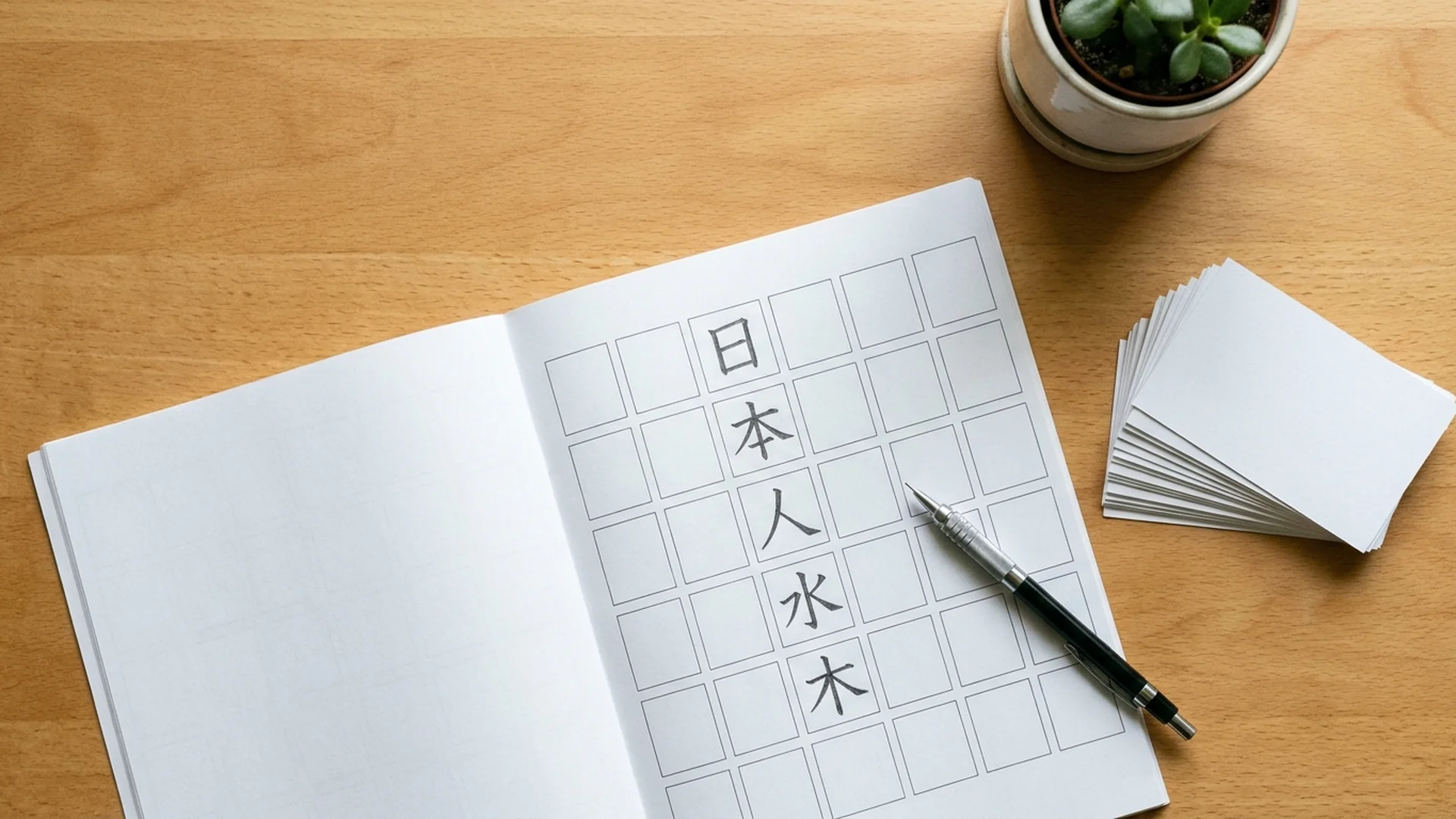
The second failure pattern is spending all your effort on writing a character from memory, stroke by stroke, before you can even reliably recognize it. Handwriting recall is the hardest version of the skill and, for most learners in 2026, one of the least useful — you’ll read far more Japanese than you’ll ever handwrite, and recognition-first practice gets you functional literacy dramatically faster than writing-first practice does.
The third pattern, and the one that actually explains the most common complaint — “I know hundreds of kanji and still can’t read a sentence” — is learning characters in isolation and never following through to how they’re actually used. A kanji studied alone as a flashcard with one English meaning attached is a party trick, not literacy. Real reading ability comes from compounds and context, which is the whole subject of the next section.
None of this means kanji is easy. It means the difficulty is front-loaded onto a few specific mistakes that are avoidable once you know to watch for them. Fix the daily unit of work, fix the recognition-before-writing order, and fix the isolation problem, and the same 2,000-plus characters that looked impossible on day one become a long but genuinely tractable project — the kind measured in months of steady practice, not some unusually rare talent for memorization.
The three things that actually matter
Strip away the total character count and the anxiety around it, and kanji learning comes down to three skills that reinforce each other. Neglect any one of them and progress stalls no matter how many hours you put in.
Radical recognition. Radicals are the recurring components kanji are built from — a few hundred shapes that combine and recombine across thousands of characters. You don’t need to memorize their names or origins to benefit from this; you just need your eye to start noticing that 語, 話, and 読 all share a component, and that shared component is doing real semantic or phonetic work. Once radical patterns become visually familiar, new kanji stop looking like random scribbles and start looking like recognizable combinations of pieces you’ve already seen — which is the difference between memorizing 2,000 unrelated shapes and memorizing a few hundred building blocks arranged in different orders.
Readings — both of them, on purpose. Most kanji have at least one on’yomi (音読み, the reading borrowed from Chinese, typically used in compounds) and one kun’yomi (訓読み, the native Japanese reading, typically used standalone or with okurigana). Learners who memorize only “the meaning” without attaching real readings end up able to recognize a character’s gist while being unable to actually read it aloud or type it — which matters more than it sounds like it should, since reading speed and reading comprehension are the same skill in practice, not two separate ones.
Context and compounds, not isolated characters. This is the one people skip, and it’s the one that actually determines whether kanji study translates into reading ability. A character studied only in isolation gives you a vague sense of meaning; the same character seen across a handful of real compounds and sentences gives you an actual, retrievable sense of how it’s used — which reading applies when, what it commonly pairs with, and how to recognize it at normal reading speed instead of sounding it out letter by letter.
These three reinforce each other more than they operate independently. Radical familiarity makes a new character faster to encode in the first place; knowing both readings means you can actually produce the character in speech or typing, not just recognize it passively on a page; and compound exposure is what turns a shaky “I think I’ve seen this before” into a confident, fast read. Skip context and compounds specifically, and the first two skills end up supporting a kind of knowledge that never quite becomes usable — which is exactly the “I know the character but can’t read the sentence” complaint from the previous section.
SRS is not optional
If there’s one piece of infrastructure that separates people who retain kanji from people who keep re-learning the same characters every few months, it’s spaced repetition. The mechanism is simple enough to explain in a sentence: instead of reviewing everything on a fixed schedule, a spaced-repetition system shows you each item right before you’re statistically likely to forget it, so the interval between reviews stretches out — a day, then a few days, then weeks, then months — as a character moves from “just learned” to “genuinely retained.”
The reason this matters more for kanji specifically than for most other study material is sheer volume. Vocabulary and grammar patterns are, in the end, a few thousand items each; kanji plus the readings and compounds attached to them is a much larger dataset to hold in working memory through brute repetition alone. Reviewing everything you’ve ever studied on a flat, un-prioritized schedule doesn’t scale — you either spend an ever-growing amount of daily time on review, or you quietly stop reviewing old material and watch it decay. An SRS solves this by concentrating your review time on the items actually at risk of being forgotten, rather than spreading it evenly across everything you’ve ever touched.
You don’t need a kanji-specific tool to get this benefit — any properly built spaced-repetition system does the job, whether it’s bundled into a broader Japanese platform, a dedicated flashcard app, or something you build yourself with physical cards. What matters is that you’re actually using one, consistently, rather than relying on periodic re-reading and hoping retention holds.
How to actually build a daily habit
The system above only works if you show up daily, so the practical question is what a sustainable daily routine actually looks like — not in the abstract, but as a concrete split of time.
A workable starting point for most learners: 5 to 10 new characters a day, plus whatever review your SRS queues up for you that day. Early on, review volume stays low and the session feels short. By week three or four, the review queue starts to genuinely dominate your daily time — this is normal and expected, not a sign you’re doing something wrong, and it’s exactly the mechanism described above working as intended.
Split your daily session roughly like this: reviews first, while your attention is freshest, since a correct answer on a character about to be forgotten is worth more than an easy correct answer on something you already know cold. New characters second, in a small enough batch that you can genuinely absorb the radical, both readings, and at least one real compound for each one — not just glance and move on. If a session runs long, it’s almost always the review queue that’s grown, which is a sign to hold new characters steady for a few days rather than add more on top of a backlog.
A realistic week looks less uniform than “10 a day, every day” implies. A typical pattern: strong sessions on weekdays when the routine is easiest to slot in, a lighter session on one weekend day where you mostly clear reviews without adding much new material, and one fully protected rest day where you do nothing and let the SRS schedule sit untouched — the interval math accounts for a day off, so skipping one day on purpose is completely different from the unplanned week-long gaps that actually derail people. What matters is that the gaps are chosen, not that there are zero gaps at all.
The single biggest predictor of whether this actually sticks isn’t the exact daily number — it’s consistency over intensity. Fifteen focused minutes every single day beats two hours once a week by a wide margin, because spaced repetition depends on regular exposure at the right intervals; skip a week and your review queue doesn’t just wait patiently, it compounds into something considerably more unpleasant to face than if you’d shown up daily. If you’re working toward a specific target — the roughly 100 kanji usually associated with JLPT N5, for instance, or the roughly 300 usually associated with N4 (a cumulative figure that includes the N5 kanji) — build the daily habit around that realistic pace rather than a crash-study sprint the week before a test date.
A note on these numbers: the JLPT does not publish an official vocabulary, kanji, or grammar list. Since the 2010 revision, it has released only level summaries and sample questions, explaining that the goal of learning Japanese is communication rather than memorising lists. Figures like these come from textbooks and learning sites, not from the JLPT itself. (Sources: JLPT official FAQ; Japanese-Language Proficiency Test on Wikipedia.)
Common mistakes that waste months
A few specific habits show up again and again in learners who’ve put in real hours and still feel stuck. Watching for these directly saves more time than almost any other single piece of advice here.
- Learning characters in isolation and stopping there. Passing a flashcard review for a kanji you’ve never seen in an actual sentence gives you a false sense of mastery. Pair new characters with real compounds and, as soon as possible, real sentences — the retrieval you’re building needs to match how you’ll actually encounter the character later.
- Over-investing in handwriting before recognition is solid. Stroke-order writing practice has real value, but doing it before recognition is fluent means you’re spending your hardest effort on your least-used skill. Get comfortable recognizing a character across different fonts and contexts first; layer in writing practice afterward if it still matters to you.
- Cramming instead of respecting the forgetting curve. Piling on 50 new characters in one sitting because you have a free afternoon feels productive and isn’t — you’ll forget most of them within days without spaced review, and you’ll have built a backlog that discourages the very consistency that actually works.
- Treating on’yomi and kun’yomi as optional extras. Skipping one reading because a character “mostly shows up” with the other eventually catches up with you the first time it appears in an unfamiliar compound or as a standalone word, and you have no retrievable reading to fall back on.
- Restarting from scratch after a break instead of just resuming. A missed week doesn’t erase months of retained characters — it just means your review queue is larger than usual for a few days. Learners who quit entirely after a lapse are almost always reacting to a swollen queue that looks worse than it is, not to genuinely lost progress.
- Chasing a bigger daily new-character count than the review load can support. Adding new characters faster than you can actually retain them doesn’t speed anything up — it just moves the same characters further down the road as a bigger, harder-to-clear backlog. If your review queue keeps growing rather than stabilizing, the fix is fewer new characters per day, not more discipline about clearing reviews faster.
Tools that actually help
You don’t strictly need a dedicated platform to apply everything above — a notebook and a basic flashcard app with spaced repetition can, in principle, get you there. In practice, most learners retain material better with a tool that handles the SRS scheduling automatically and gives you compounds and context alongside each character, rather than building that structure by hand.
Nihoner bundles kanji games, stroke-order practice, and a dictionary search that surfaces real compounds and usage examples into one account, which covers the recognition-plus-context combination this article has been arguing for throughout — how its dictionary and course structure actually fit together day to day is worth reading if you want the fuller picture before committing to it. WaniKani builds around the same three elements from a different angle. Its level structure runs radicals first, then kanji, then vocabulary, so radical recognition is baked into the learning order itself rather than something you pick up as a side effect. Readings get the same deliberate treatment: each kanji lesson introduces the on’yomi up front, and the kun’yomi arrives specifically when that kanji later shows up inside a vocabulary word — so you’re not left with a passive, meaning-only grasp of either reading. And because every kanji you learn is immediately followed by a batch of real vocabulary built from it, the context and compounds this article has been pushing for aren’t a separate step you have to go looking for — they’re part of the same level you just cleared.
Neither is objectively better than the other; they’re built for slightly different starting points — Nihoner if you want kanji study folded into a broader Japanese platform with its own dictionary lookup, WaniKani if you want a purpose-built system where the radical-to-kanji-to-vocabulary order and the mnemonic-driven readings are the entire product. What matters more than which specific tool you pick is whether it actually gives you all three things from earlier in this article — radical exposure, both readings, and real compounds in context — rather than isolated flashcards and a hope that meaning alone will eventually turn into reading ability.


コメント