
This article contains affiliate links to Nihoner. If you sign up through them, we may earn a commission at no extra cost to you. It does not affect which options we recommend.
What N5 actually tests
JLPT N5 is the entry-level tier of the Japan Foundation’s official Japanese proficiency test. It checks whether you can understand basic Japanese used in everyday situations and classroom settings — not fluent conversation, not reading a newspaper, just the foundational layer everything else builds on.
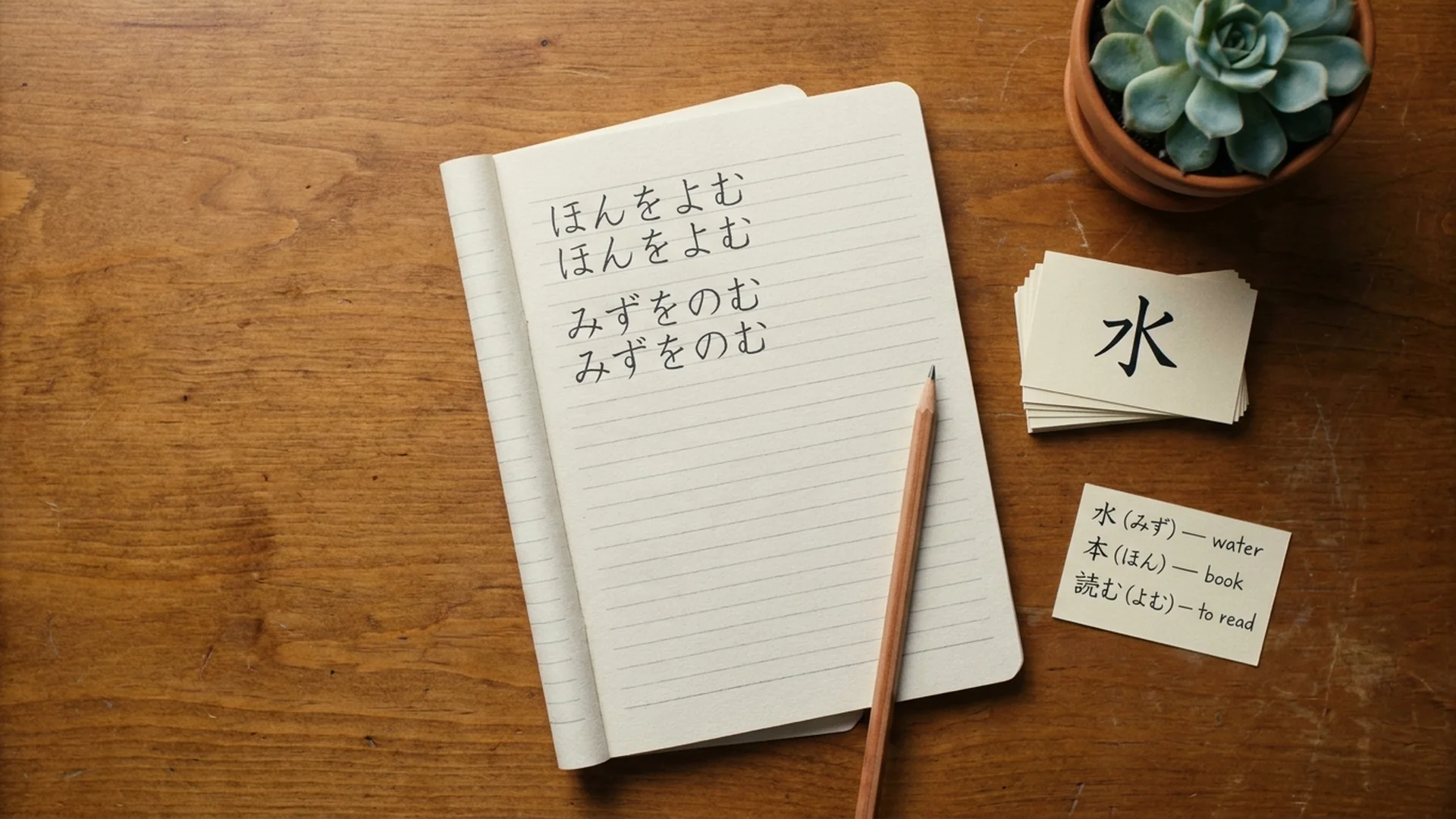
The exam covers three sections: vocabulary/grammar, reading, and listening. There’s no speaking component, which surprises some learners — you can technically pass N5 without ever having a real conversation in Japanese. That’s worth keeping in mind: passing N5 and being able to actually talk to someone are two different skills, and this roadmap treats them separately.
The four things you actually need to cover
1. Hiragana and katakana (before anything else)
If you can’t read the two phonetic alphabets fluently, everything else is slower than it needs to be. This should be the first 1–2 weeks of study, full stop. Don’t move on to grammar or kanji until reading kana feels close to automatic.
What covers this well: Nihoner‘s kana games, or Duolingo’s early lessons, both work fine here — this is a case where the specific tool matters less than just doing daily repetition.
2. Core grammar patterns
N5 grammar is a small, fairly contained set — textbooks and learning sites commonly estimate roughly 100 patterns, covering things like basic particles (は, が, を, に, で), simple verb conjugations (present, past, negative), and basic sentence connectors. The JLPT doesn’t publish a grammar list, but any N5 textbook covers essentially the same ground, so you can work through it systematically.
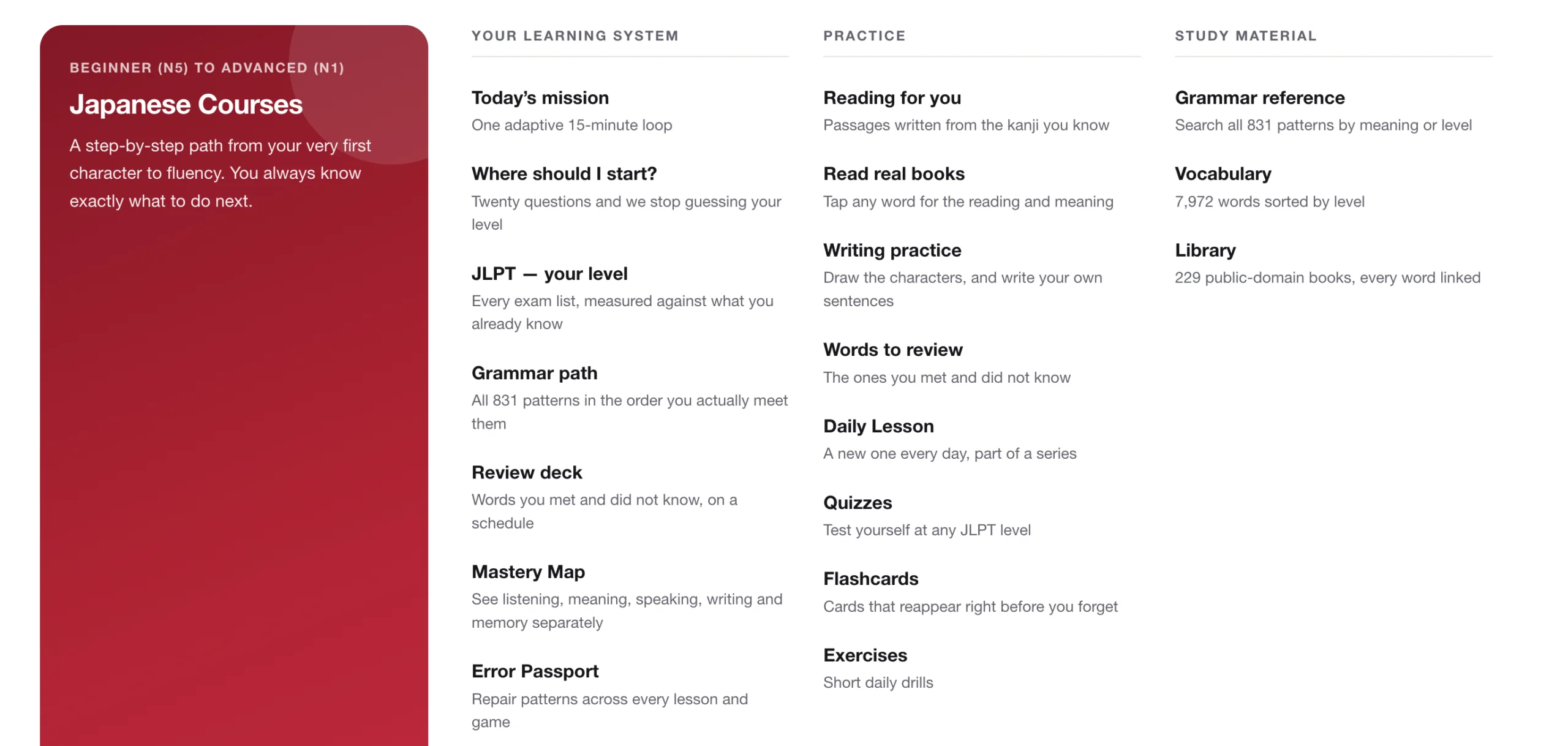
What covers this well: Nihoner’s “Grammar path” feature is built around exactly this — patterns ordered by JLPT level. I covered it in more detail in my Nihoner review.
3. Vocabulary (roughly 800 words)
N5 vocabulary is smaller than people expect — commonly estimated at around 800 words, focused on everyday objects, basic verbs, time expressions, and simple adjectives. The realistic goal isn’t memorizing a giant list in isolation; it’s recognizing these words in context enough times that they stick.
A note on these numbers: the JLPT does not publish an official vocabulary, kanji, or grammar list. Since the 2010 revision, it has released only level summaries and sample questions, explaining that the goal of learning Japanese is communication rather than memorising lists. Figures like these come from textbooks and learning sites, not from the JLPT itself. (Sources: JLPT official FAQ; Japanese-Language Proficiency Test on Wikipedia.)
What covers this well: Spaced-repetition tools (flashcards that resurface words right before you’d forget them) are the efficient way to do this. WaniKani is more kanji-focused than vocabulary-focused, so for pure N5 vocabulary, a dedicated vocab deck or Nihoner’s review deck works better.
4. Basic kanji (around 100 characters)
N5 kanji are usually estimated at roughly 100 characters — a small fraction of the ~2,000 in general use, but still a real hurdle if you’ve never studied characters before. Focus on recognition first (being able to read it in a sentence) before worrying about writing it from memory.
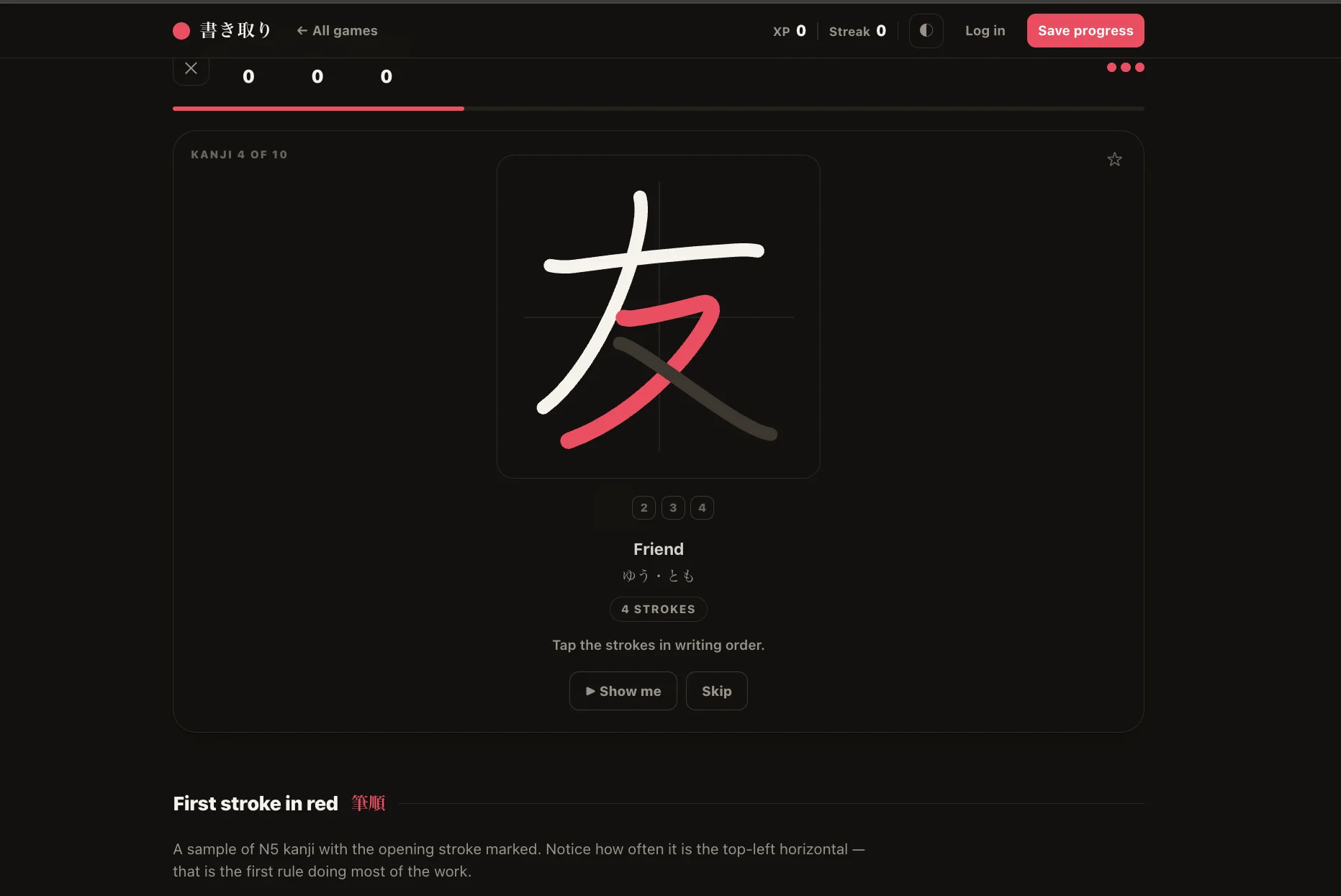
What covers this well: Nihoner‘s stroke-order games and kanji drills are appropriately scoped for this level. Save WaniKani for after N5, once you’re ready to scale up kanji volume seriously.
A realistic timeline
There’s no single “correct” pace, but here’s a grounded estimate for someone studying consistently, 20–30 minutes a day:
- Weeks 1–2: Hiragana and katakana to fluency
- Weeks 3–10: Core grammar patterns, introduced gradually, revisited constantly
- Ongoing from week 3: Vocabulary flashcards, a little every day rather than cramming
- Weeks 6–14: Kanji, layered in once basic grammar feels stable
- Weeks 12–16: Practice tests and timed reading/listening sections
This roadmap covers the order to study things in, and a daily 20–30 minute habit will take you through the material in about 3–4 months. Reaching a level where you can pass the exam is a different question: survey data collected from Japanese language schools between 2010 and 2015 puts N5 at roughly 250–450 hours for learners who already read kanji, and 325–600 hours for those who do not. These are self-reported figures from language institutions, not an official JLPT standard.
The 3–4 months will be shorter if you already know kana or have some exposure to Japanese, and longer if your schedule is inconsistent — and that’s fine. The JLPT is held in July and December in Japan, and outside Japan some cities offer it only in July or only in December, so check the schedule for your test site. Either way, there’s no need to rush toward an arbitrary date.
Where speaking practice fits in
Since N5 has no speaking component, it’s tempting to skip conversation practice entirely and just grind grammar and vocabulary. I’d push back on that. Even 15–20 minutes a week with a tutor — through italki or Preply — does two things a solo app can’t: it forces you to retrieve vocabulary under time pressure, and it catches pronunciation habits early, before they calcify. You don’t need much. You need consistency. If tutoring alone doesn’t give you enough of that consistency, it’s worth knowing what a more structured, classroom-based option actually looks like in comparison.

After N5: building long-term kanji skills
WaniKani is worth knowing about once you’re past N5. It’s a spaced-repetition (SRS) system focused specifically on kanji and related vocabulary — you work through radicals, then kanji, then vocabulary in a fixed sequence, with each character tied to a mnemonic story. It’s genuinely effective for long-term retention, but it’s a serious time commitment: finishing all 60 levels realistically takes over a year of daily use.
That makes it a poor fit for N5 prep specifically — if you just need the roughly 100 kanji usually associated with this level, Nihoner‘s structured approach will get you there faster. Save WaniKani for after you’ve built your grammar foundation and want to keep expanding your kanji reading ability long-term.
As for the exam itself: once N5 material feels solid rather than shaky, the JLPT N4 Roadmap picks up exactly where this one leaves off.


コメント